The following descriptions include a sample element from each periodic table. All of the tables will print on a single 8½ x 11 page, though some may require color to retain their appearance. The quality of the results will depend in large part on the quality of your printer. Only seven of these tables are my creation; all rights are retained by the original authors of the others.
|
 This is the second "Build Your Own Table" website to which I have linked. This is online software that allows an amazing amount of customization, from color schemes to the data that you want displayed. Electronegativity - yes. Common ions - yes. Atomic mass, electron configuration, density, boiling point, freezing point - all can be included by simply checking a box. You can also customize font size and add a logo. When you are all done creating your masterpiece, you can download it as a pdf file. This is the second "Build Your Own Table" website to which I have linked. This is online software that allows an amazing amount of customization, from color schemes to the data that you want displayed. Electronegativity - yes. Common ions - yes. Atomic mass, electron configuration, density, boiling point, freezing point - all can be included by simply checking a box. You can also customize font size and add a logo. When you are all done creating your masterpiece, you can download it as a pdf file.
|
|
 I recently decided that the old CA State table we used for years needed to go away. It only listed 109 elements(!). Also, the California Department of Education recently published a set of equations and constants as a resource for our new CAST (California Science Test). I have to believe that the CAST will include an online periodic table, so I have cobbled together the equations and constants from CAST that I think will apply to Chemistry, and combined it here with an up-to-date periodic table in a two-sided resource sheet that my students will be using in class. I recently decided that the old CA State table we used for years needed to go away. It only listed 109 elements(!). Also, the California Department of Education recently published a set of equations and constants as a resource for our new CAST (California Science Test). I have to believe that the CAST will include an online periodic table, so I have cobbled together the equations and constants from CAST that I think will apply to Chemistry, and combined it here with an up-to-date periodic table in a two-sided resource sheet that my students will be using in class.
|
|
 An Earth Scientist's Periodic Table, this is available in number of sizes on the linked page. From the website: "The Earth Scientist's Periodic Table of the Elements and Their Ions is a new periodic table designed to contextualize trends in geochemistry, mineralogy, aqueous chemistry, and other natural sciences. It is fundamentally different from the conventional periodic table in organizing entities by charge and consequently in showing many elements multiple times because of the multiple charges or valence states taken by those elements. These differences make the new table much more effective in showing trends and patterns in geochemistry, mineralogy, aqueous chemistry, and other natural sciences." I like it so much I ordered a wall copy HERE An Earth Scientist's Periodic Table, this is available in number of sizes on the linked page. From the website: "The Earth Scientist's Periodic Table of the Elements and Their Ions is a new periodic table designed to contextualize trends in geochemistry, mineralogy, aqueous chemistry, and other natural sciences. It is fundamentally different from the conventional periodic table in organizing entities by charge and consequently in showing many elements multiple times because of the multiple charges or valence states taken by those elements. These differences make the new table much more effective in showing trends and patterns in geochemistry, mineralogy, aqueous chemistry, and other natural sciences." I like it so much I ordered a wall copy HERE
|
|
 This table was sent to me by a gentleman named Jim Parker. He is generously sharing it with us. The elements are colored by element class, and the symbols are done in white rather than the traditional black. Jim designed this to replace a tattered periodic table that was hanging above his desk at home. It is a stunning table, and is also notably complete through element 118. I have forwarded to Jim several requests from movie set directors wanting his permission to use this table in movies. This table was sent to me by a gentleman named Jim Parker. He is generously sharing it with us. The elements are colored by element class, and the symbols are done in white rather than the traditional black. Jim designed this to replace a tattered periodic table that was hanging above his desk at home. It is a stunning table, and is also notably complete through element 118. I have forwarded to Jim several requests from movie set directors wanting his permission to use this table in movies.
|
|
 Kathleen Schenk, a Middle-School science teacher from Indiana, was generous enough to share with everyone this activity that she uses for teaching about matter and the periodic table. The activity includes identifying group and periods by number, as well as color-coding elements by class. What really sets this apart is that it is in Excel format (.xlsx) so you can edit it as you please. And did I mention, she also included the key, in Excel format as well. Kathleen Schenk, a Middle-School science teacher from Indiana, was generous enough to share with everyone this activity that she uses for teaching about matter and the periodic table. The activity includes identifying group and periods by number, as well as color-coding elements by class. What really sets this apart is that it is in Excel format (.xlsx) so you can edit it as you please. And did I mention, she also included the key, in Excel format as well.
|
|
   I was very excited to receive these tables from Dr. Zoran Zdravkovski of the Institute of Chemistry, University Ss. Cyril & Methodius in Skopje, Macedonia. He reports that the first two are tables he gives to his students. They are indeed written in Macedonian! The third table is a more detailed table, and also in Macedonian. According to Dr. Zdravkovski, "This is a scan of a Periodic table which a colleague of mine, Prof. Ivan Grozdanov, and I did and was published in 2000." It is beautifully organized and presented. I was very excited to receive these tables from Dr. Zoran Zdravkovski of the Institute of Chemistry, University Ss. Cyril & Methodius in Skopje, Macedonia. He reports that the first two are tables he gives to his students. They are indeed written in Macedonian! The third table is a more detailed table, and also in Macedonian. According to Dr. Zdravkovski, "This is a scan of a Periodic table which a colleague of mine, Prof. Ivan Grozdanov, and I did and was published in 2000." It is beautifully organized and presented.
|
|
 This is a first for this site - a link to a "Design Your Own" Periodic Table. The site allows you to customize the periodic table, with the information you require, and creates a unique PDF document from your preferences. You can even create a table with Lutetium (Lu) and Lawrencium (Lr) in the d-block if desired. This is a first for this site - a link to a "Design Your Own" Periodic Table. The site allows you to customize the periodic table, with the information you require, and creates a unique PDF document from your preferences. You can even create a table with Lutetium (Lu) and Lawrencium (Lr) in the d-block if desired.
|
|
 The periodic table linked here is a companion resource to a Nova segment called "Hunting Elements". As you can see, it contains only basic information, but if you look at the document, it is beautifully produced and suitable for printing as a wall-sized table. It also contains inserts on some common elements, including pictures of samples. The table is color-coded by element class. They also produced a black and white version that is intended for students to use to color the elements by class. The periodic table linked here is a companion resource to a Nova segment called "Hunting Elements". As you can see, it contains only basic information, but if you look at the document, it is beautifully produced and suitable for printing as a wall-sized table. It also contains inserts on some common elements, including pictures of samples. The table is color-coded by element class. They also produced a black and white version that is intended for students to use to color the elements by class.
|
|
 This is a periodic table produced by the Merck corporation. It contains a wealth of information about each element, and the key is in both English and (naturally) German. The elements are color-coded by element class, and the table has a resolution that would allow printing at a very large size. It is complete only through element 112. This is a periodic table produced by the Merck corporation. It contains a wealth of information about each element, and the key is in both English and (naturally) German. The elements are color-coded by element class, and the table has a resolution that would allow printing at a very large size. It is complete only through element 112.
|
|
 This is a beautifully illustrated periodic table produced by the Foundation for Education, Science and Technology. It is color coded by element class and also includes phase information. It would be a great table for classes up through middle school. You can also get the large JPEG Version of the table. This is a beautifully illustrated periodic table produced by the Foundation for Education, Science and Technology. It is color coded by element class and also includes phase information. It would be a great table for classes up through middle school. You can also get the large JPEG Version of the table.
|
|
 Another amazing, beautifully illustrated periodic table! The author (Keith Enevoldsen)has included illustrations for uses of the elements, element classes, and even a "word" version or the table. You can download various versions of the table from his website. You will also want to look at some of his other beautiful work related to chemistry. In addition, he sells posters of these document through his Cafe Press page. Another amazing, beautifully illustrated periodic table! The author (Keith Enevoldsen)has included illustrations for uses of the elements, element classes, and even a "word" version or the table. You can download various versions of the table from his website. You will also want to look at some of his other beautiful work related to chemistry. In addition, he sells posters of these document through his Cafe Press page.
|
|
 A truly unique periodic table, this table focuses on the abundance of isotopes of the various elements. Produced by IUPAC, the International Union of Pure and Applied Chemists, this table is absolutely essential to instruction on the difference between atomic mass and average atomic mass. A truly unique periodic table, this table focuses on the abundance of isotopes of the various elements. Produced by IUPAC, the International Union of Pure and Applied Chemists, this table is absolutely essential to instruction on the difference between atomic mass and average atomic mass.
|
|
 A company called Quantum Design produced this table, which focuses on phase transition temperatures and properties such as superconductivity and ferromagnetism. This is a colorful, perfectly organized table that emphasizes properties of the elements that are normally not included in a periodic table. A company called Quantum Design produced this table, which focuses on phase transition temperatures and properties such as superconductivity and ferromagnetism. This is a colorful, perfectly organized table that emphasizes properties of the elements that are normally not included in a periodic table.
|
|
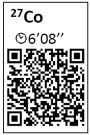 Welcome to the power of technology in the 21st Century! This table was sent to my by the author, Dr. Vasco D. B. Bonifacio of the Universidade Nova de Lisboa. Quoting his own abstract, this is "A quick response coded audio periodic table of the elements (QR-APTE) developed using free online resources. The potential of QR-APTE was tested using a smart phone and is envisaged to become a truly powerful tool to teach chemistry to blind and visually impaired students under a mobile-learning environment." You can read the original article HERE. Welcome to the power of technology in the 21st Century! This table was sent to my by the author, Dr. Vasco D. B. Bonifacio of the Universidade Nova de Lisboa. Quoting his own abstract, this is "A quick response coded audio periodic table of the elements (QR-APTE) developed using free online resources. The potential of QR-APTE was tested using a smart phone and is envisaged to become a truly powerful tool to teach chemistry to blind and visually impaired students under a mobile-learning environment." You can read the original article HERE.
|
|
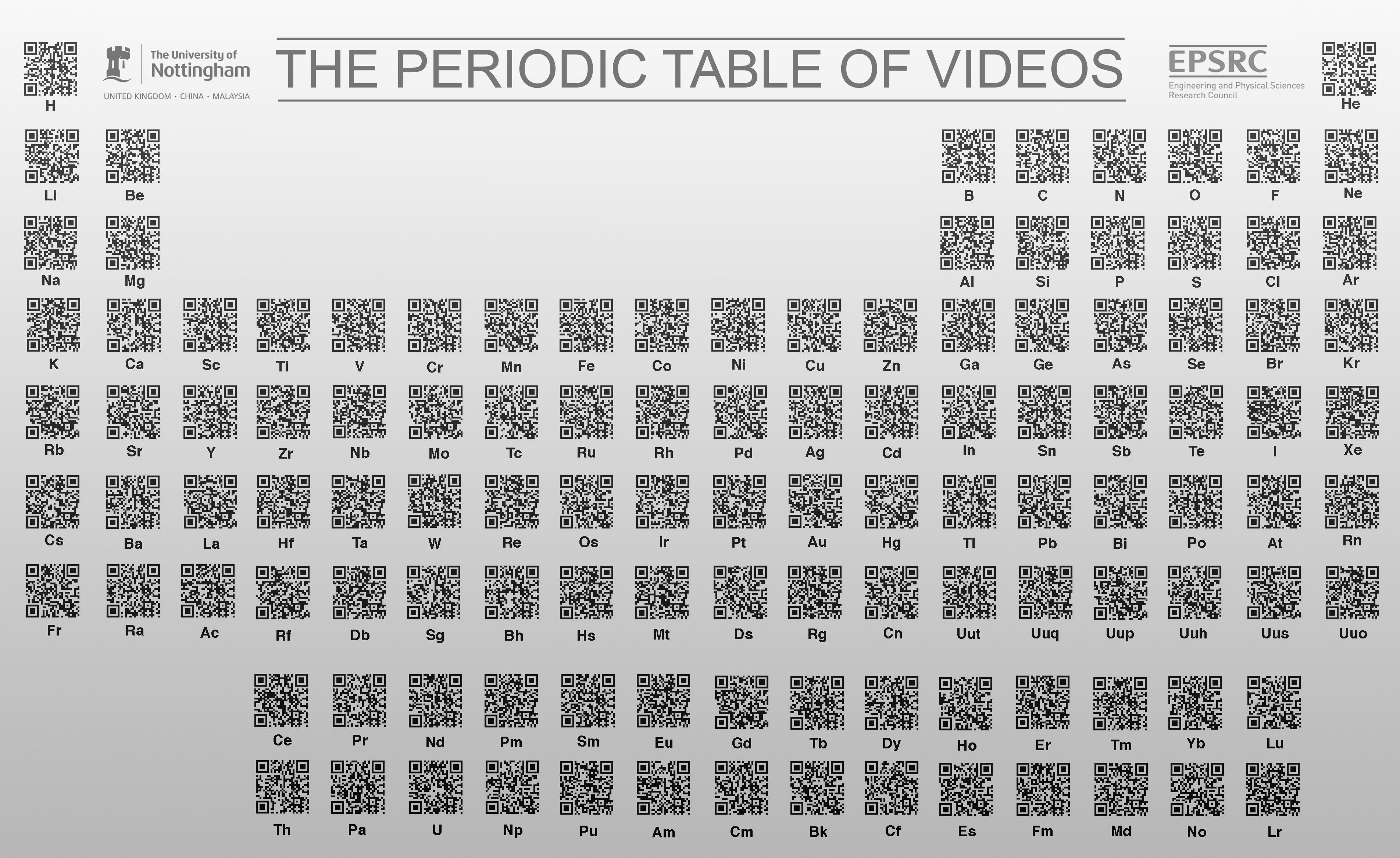
 One of my favorite instructional resources on the Internet is the Periodic Table of Videos, produced by the University of Nottingham. This QR coded table links each element directly to the corresponding video resource on their website. It is in JPEG format. Various sized of this resource can be found on their Flicker posting HERE. One of my favorite instructional resources on the Internet is the Periodic Table of Videos, produced by the University of Nottingham. This QR coded table links each element directly to the corresponding video resource on their website. It is in JPEG format. Various sized of this resource can be found on their Flicker posting HERE.
|
|
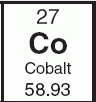 This is the periodic table used with the California Standardized Test in Chemistry. The back of the table includes equations, constants and other information available to students on the test. This is the table that we use all year long in my classes, so that students will be familiar with it when they take their CST in April. This is the periodic table used with the California Standardized Test in Chemistry. The back of the table includes equations, constants and other information available to students on the test. This is the table that we use all year long in my classes, so that students will be familiar with it when they take their CST in April.
|
|
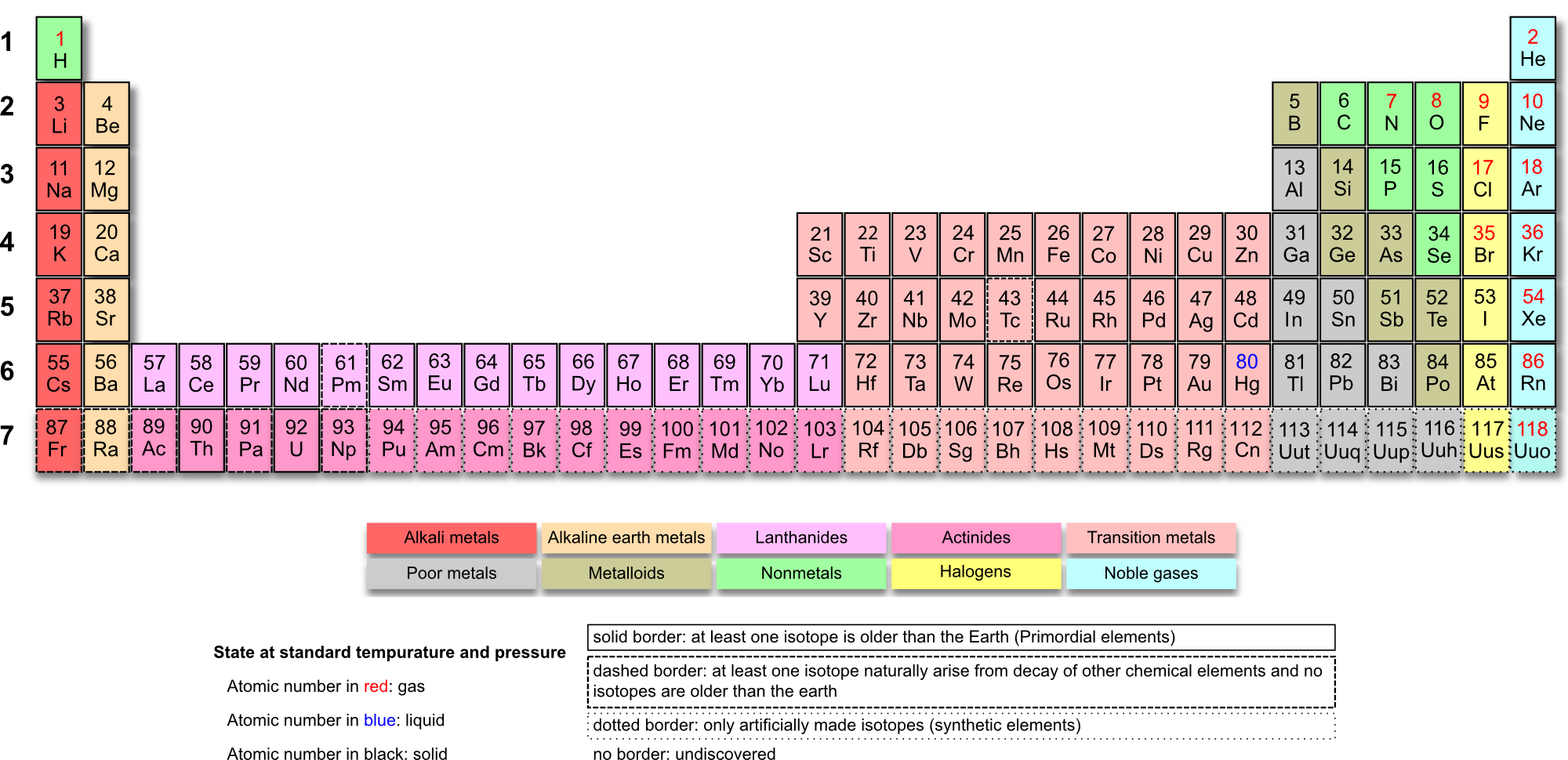
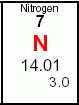 This table is my own creation. Average molar masses are rounded to two decimal places. The table also includes electronegativity values. Element symbols are color coded (black = solid, red = gas, blue = liquid). Updated November 2019 to reflect correct names for all elements through 118. This table is my own creation. Average molar masses are rounded to two decimal places. The table also includes electronegativity values. Element symbols are color coded (black = solid, red = gas, blue = liquid). Updated November 2019 to reflect correct names for all elements through 118.
|
|
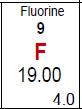 This table is Joel Weiner's improved version of my table (above). He has improved the font size and the overall appearance of the table. He has also provided his Adobe Illustrator (.ai) file from which he generated this table. This table is Joel Weiner's improved version of my table (above). He has improved the font size and the overall appearance of the table. He has also provided his Adobe Illustrator (.ai) file from which he generated this table.
|
|
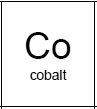 This is the periodic table that was sent to me by Josh Blaustein, a chemistry teacher from New York. In his own words, " I was looking for a periodic table with nothing other than element names and symbols - not even atomic numbers - for my class to use during the test at the end of the periodic table unit. (I didn't even want the atomic numbers so that they truly realize how much information is in the periodic table's layout and ordering alone - even without making atomic numbers explicit." If you are interested in the original Word file, you can contact Josh directly at SAR High School. This is the periodic table that was sent to me by Josh Blaustein, a chemistry teacher from New York. In his own words, " I was looking for a periodic table with nothing other than element names and symbols - not even atomic numbers - for my class to use during the test at the end of the periodic table unit. (I didn't even want the atomic numbers so that they truly realize how much information is in the periodic table's layout and ordering alone - even without making atomic numbers explicit." If you are interested in the original Word file, you can contact Josh directly at SAR High School.
|
|
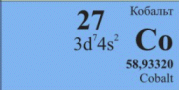 Years ago I had a student from Russia in my AP Chemistry class. Daria brought few things with her to California, but one of the essentials that she brought was her own Russian periodic table. Despite my best efforts, she steadfastly refused the table we used in favor of her own. Though similar, there are some significant difference in the way the two tables are organized. Also, the Russian table always has Mendeleev's picture on it, and this particular table has the names of the elements in both Russian and English. Years ago I had a student from Russia in my AP Chemistry class. Daria brought few things with her to California, but one of the essentials that she brought was her own Russian periodic table. Despite my best efforts, she steadfastly refused the table we used in favor of her own. Though similar, there are some significant difference in the way the two tables are organized. Also, the Russian table always has Mendeleev's picture on it, and this particular table has the names of the elements in both Russian and English.
|
|
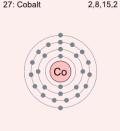 This periodic table (in .png format) was created by WikiMedia Commons user Greg Robson. What is unique is that each element is detailed with the name, symbol and number of electrons in each shell (by actually showing the shells. This is a large file (~ 2 mb) and you will need to zoom in to see the quality of the image once you open it in a browser or graphics program. You may also be interested in the full SVG (Scalable Vector Graphics) file. As an SVG file, you could have this table printed up to wall-size for your classroom, lecture hall or lab. This periodic table (in .png format) was created by WikiMedia Commons user Greg Robson. What is unique is that each element is detailed with the name, symbol and number of electrons in each shell (by actually showing the shells. This is a large file (~ 2 mb) and you will need to zoom in to see the quality of the image once you open it in a browser or graphics program. You may also be interested in the full SVG (Scalable Vector Graphics) file. As an SVG file, you could have this table printed up to wall-size for your classroom, lecture hall or lab.
|
|
 This is a more basic table found on WikiMedia Commons and produced by user Armtuk. Element classes and phases are color coded. I've posted this in .pdf format, but this table has a high-resolution full SVG (Scalable Vector Graphics) file. The SVG file is editable in programs such as Inkscape, and loses no resolution. This is a more basic table found on WikiMedia Commons and produced by user Armtuk. Element classes and phases are color coded. I've posted this in .pdf format, but this table has a high-resolution full SVG (Scalable Vector Graphics) file. The SVG file is editable in programs such as Inkscape, and loses no resolution.
|
|
 La Tabla Periodica - the periodic table in Spanish. This very detailed periodic table was created by WikiMedia Commons user Joseph Anglada. I've edited the file to include the color key to the element classes. This is a large file (~ 3 mb) and you will need to zoom in to see the quality of the image once you open it in a browser or graphics program. You may also be interested in the full SVG (Scalable Vector Graphics) file. As an SVG file, you can edit it in programs such as Inkscape, and loses no resolution. La Tabla Periodica - the periodic table in Spanish. This very detailed periodic table was created by WikiMedia Commons user Joseph Anglada. I've edited the file to include the color key to the element classes. This is a large file (~ 3 mb) and you will need to zoom in to see the quality of the image once you open it in a browser or graphics program. You may also be interested in the full SVG (Scalable Vector Graphics) file. As an SVG file, you can edit it in programs such as Inkscape, and loses no resolution.
|
|
 This is a color-coded table found on WikiMedia Commons and posted by user Napy1kenobi. The table was originally created in French and posted as an SVG file. I've translated it to English and posted .pdf format, but in the spirit of "share-and-share-alike" I am also providing the editable, high-resolution, full SVG (Scalable Vector Graphics) file. The SVG file is editable in programs such as Inkscape, and loses no resolution. This is a color-coded table found on WikiMedia Commons and posted by user Napy1kenobi. The table was originally created in French and posted as an SVG file. I've translated it to English and posted .pdf format, but in the spirit of "share-and-share-alike" I am also providing the editable, high-resolution, full SVG (Scalable Vector Graphics) file. The SVG file is editable in programs such as Inkscape, and loses no resolution.
|
|
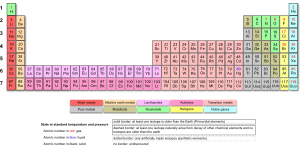 Inspired by a video from our friends at PeriodicVideos.com, I decided to produce a long form periodic table, which includes the "f" block elements in their correct place. These tables aren't popular for print purposes because they don't resolve well on a normal printed page, but they are great for teaching the organization of the periodic table. I used existing work done on WikiMedia Commons to produce the table in Inkscape. I produced two files in .png format, a 1000 pixel width, and a 2000 pixel width. Additionally, I post here the full SVG (Scalable Vector Graphics) file. In keeping with the spirit in which the source materials were created, you are free to "share, and share alike." Inspired by a video from our friends at PeriodicVideos.com, I decided to produce a long form periodic table, which includes the "f" block elements in their correct place. These tables aren't popular for print purposes because they don't resolve well on a normal printed page, but they are great for teaching the organization of the periodic table. I used existing work done on WikiMedia Commons to produce the table in Inkscape. I produced two files in .png format, a 1000 pixel width, and a 2000 pixel width. Additionally, I post here the full SVG (Scalable Vector Graphics) file. In keeping with the spirit in which the source materials were created, you are free to "share, and share alike."
|
|
 This table shows the ions formed by the elements. It also contains an excellent table of polyatomic ions. It is the product of Joel Weiner, who teaches at Evanston Township High School in Evanston, Illinois. Dr. Weiner has generously provided the original, editable Macromedia Freehand file. This table shows the ions formed by the elements. It also contains an excellent table of polyatomic ions. It is the product of Joel Weiner, who teaches at Evanston Township High School in Evanston, Illinois. Dr. Weiner has generously provided the original, editable Macromedia Freehand file.
|
|
 This table, also produced by Dr. Joel Weiner of Evanston Township High School, is identical to the one above, except that it does not show the ions of the representative elements. The idea behind this version is that students should know the ions formed by the representative elements since it is a periodic property. This table, also produced by Dr. Joel Weiner of Evanston Township High School, is identical to the one above, except that it does not show the ions of the representative elements. The idea behind this version is that students should know the ions formed by the representative elements since it is a periodic property.
|
|
 (Updated 10/5/2022) Here is an updated table from a gentleman named Nigel, that replaces an older version. With the help of his daughter, it has been improved and contains new information. This is a large pdf file (~5.8 mb) but it is worth it. This would be suitable for publishing as a professional wall-table. If you would prefer, you may download a Network Graphic (PNG) version of this table. (Updated 10/5/2022) Here is an updated table from a gentleman named Nigel, that replaces an older version. With the help of his daughter, it has been improved and contains new information. This is a large pdf file (~5.8 mb) but it is worth it. This would be suitable for publishing as a professional wall-table. If you would prefer, you may download a Network Graphic (PNG) version of this table.
|
|
 (Updated 10/5/2022) Nigel, with the help of his daughter, has also produced an updated color version of his periodic table. This is a beautiful table that includes a color key for the common element classes, as well as the phases. This is a very large file (~19.4 mb), but suitable for large-scale printing because it will maintain it's resolution. If you would prefer, you may download a Network Graphic (PNG) version of this table (also large, ~13.3mb). (Updated 10/5/2022) Nigel, with the help of his daughter, has also produced an updated color version of his periodic table. This is a beautiful table that includes a color key for the common element classes, as well as the phases. This is a very large file (~19.4 mb), but suitable for large-scale printing because it will maintain it's resolution. If you would prefer, you may download a Network Graphic (PNG) version of this table (also large, ~13.3mb).
|
|
 Mark Brown sent me this modification based on an older version of Nigel's table. This table is so pretty that I kept it at its original resolution. Because of that, this is a BIG (~6mb) file. You can print it as a single page table, or have it printed as a wall size periodic table. Mark Brown sent me this modification based on an older version of Nigel's table. This table is so pretty that I kept it at its original resolution. Because of that, this is a BIG (~6mb) file. You can print it as a single page table, or have it printed as a wall size periodic table.
|
|
 Do you ever wonder what uses there are for all of these elements? I do, and so do my students. BP (British Petroleum), The Association of the British Pharmaceutical Industry, The Chemical Industry Education Centre, and the Royal Society of Chemistry collaborated to produce a fantastic periodic table that addresses those questions. BP has also published a very nice interactive periodic table activity HERE but to access it, you will need to register (for free). Do you ever wonder what uses there are for all of these elements? I do, and so do my students. BP (British Petroleum), The Association of the British Pharmaceutical Industry, The Chemical Industry Education Centre, and the Royal Society of Chemistry collaborated to produce a fantastic periodic table that addresses those questions. BP has also published a very nice interactive periodic table activity HERE but to access it, you will need to register (for free).
|
|
 This is a table sent to me by Jon Wittwer, PhD. His stated goal was to "create a table that would pack as much property data onto a single 8 1/2 x 11 sheet of paper as reasonably possible." I would say he has clearly succeeded! The link will take you to his site where you can access the color or black and white pdf versions of the table. This is a table sent to me by Jon Wittwer, PhD. His stated goal was to "create a table that would pack as much property data onto a single 8 1/2 x 11 sheet of paper as reasonably possible." I would say he has clearly succeeded! The link will take you to his site where you can access the color or black and white pdf versions of the table.
|
|
 This is a very basic table that I use in class to have students color-code the element classes in our standards. It has an area for a color key for alkali metals, alkaline earth metal, transition metals, metalloids, nonmetals, halogens and noble gases. This is a very basic table that I use in class to have students color-code the element classes in our standards. It has an area for a color key for alkali metals, alkaline earth metal, transition metals, metalloids, nonmetals, halogens and noble gases.
|
|
 From the premiere Internet periodic table, the WebElements periodic table. Includes the symbol, name, atomic number and the atomic mass. From the premiere Internet periodic table, the WebElements periodic table. Includes the symbol, name, atomic number and the atomic mass.
|
|
 A periodic table with color, from the folks at the Lawrence Berkeley Laboratory. Includes the usual information, as well as electron configuration, melting point, boiling point, oxidation states, and percent abundance in the universe. A periodic table with color, from the folks at the Lawrence Berkeley Laboratory. Includes the usual information, as well as electron configuration, melting point, boiling point, oxidation states, and percent abundance in the universe.
|
|
 This color table from Jefferson Lab's educational site is ideal for elementary and middle school. It is eye catching, with clever symbols for phases and other properties. To top it off, each element is hyperlinked to reference material on the element at the JLab website, Education.JLab.org. This color table from Jefferson Lab's educational site is ideal for elementary and middle school. It is eye catching, with clever symbols for phases and other properties. To top it off, each element is hyperlinked to reference material on the element at the JLab website, Education.JLab.org.
|
|
This is the (mostly) black and white version of the Jefferson Lab periodic table at the left. Not quite as eye-catching as the color version, but definitely cheaper to print. Like the color table, it is hyperlinked to the Jefferson Lab educational site.
|
|
 Los Alamos Nuclear Lab provides this uniquely colorful table. It has the usual information as well as noble-gas configuration notation for each element. Updated in December, 2016. Los Alamos Nuclear Lab provides this uniquely colorful table. It has the usual information as well as noble-gas configuration notation for each element. Updated in December, 2016.
|
|
 This is quite possibly the nicest looking, and one of the most informative of all of the tables I have gathered. It is produced by the Physical Measurement Laboratory (PML) at NIST, the National Institute of Standards and Technology. In addition to a wealth of information on each element, it also contains a table of physical constants. A stunning color scheme completes this fine table. This is quite possibly the nicest looking, and one of the most informative of all of the tables I have gathered. It is produced by the Physical Measurement Laboratory (PML) at NIST, the National Institute of Standards and Technology. In addition to a wealth of information on each element, it also contains a table of physical constants. A stunning color scheme completes this fine table.
|


 Unless otherwise indicated, the following tables are in Acrobat PDF format. To view and print these files, you will need to install the free Adobe Acrobat Reader program on your computer. The program can be downloaded from the Adobe Website.